By Brian Sullivan, CSP
Showing a buyer everything feels thorough. Most of the time it just hands them homework. The best reps find the problem first and show only what solves it.
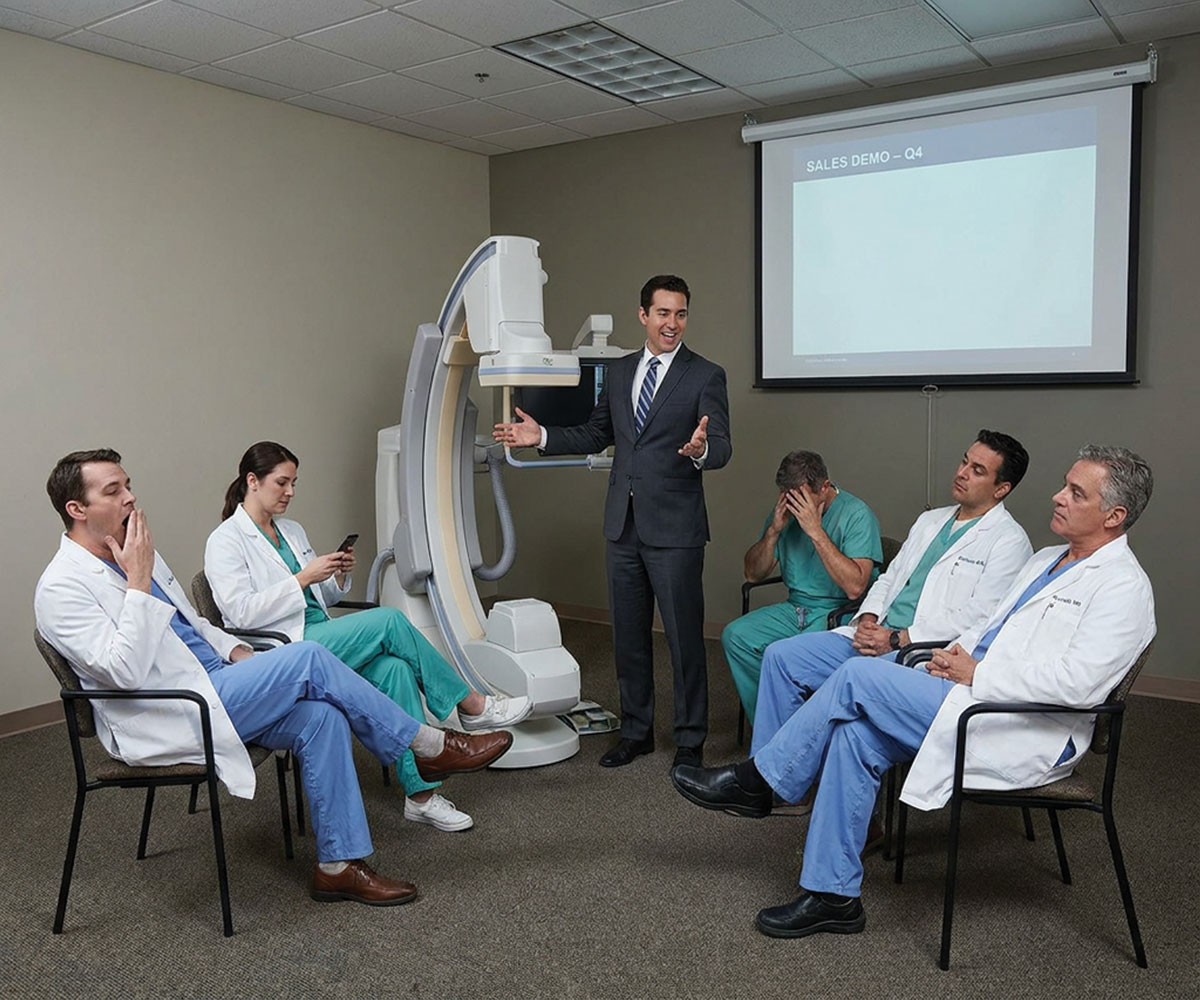
I rode along with a rep named Nate on a Tuesday afternoon to a four-location orthopedic group evaluating a point-of-use inventory system for its surgery center. The practice administrator was there, along with the OR manager and a materials coordinator who clearly had somewhere else to be. Nate set up his laptop. The administrator leaned back and said five dangerous words: “OK, show me what you’ve got.”
And Nate did. All of it. Receiving. Par levels. Barcode scanning. Charge capture. Vendor reports. User permissions. Forty-five minutes, nine modules, not one technical hiccup.
They were polite. They asked two questions, both about price, and the administrator said they’d talk internally and get back to him.
In the car, Nate let out a breath and said, “I thought that went great.”
“You showed them everything,” I said, “except why they should buy.”
More isn’t value. It’s homework.
Most reps believe a longer demo builds more value. It sounds logical, and it’s almost always wrong. Every screen that doesn’t connect to the buyer’s problem forces them to do the translation work themselves. Most won’t bother. They’ll nod, thank you for your time and keep doing what they’ve always done.
Here’s the part of Nate’s call that bothered me. In the first five minutes, while he was plugging in his laptop, the OR manager mentioned they’d had two cases delayed that month because an implant showed in stock and wasn’t on the shelf.
That was the whole sale. Nate’s system fixes exactly that problem. He got to it around minute 31, for maybe 90 seconds, sandwiched between the reporting dashboard and the permissions settings. By then the OR manager was checking her phone. He heard it. He just didn’t use it.
Why reps show everything
Nobody gives the full demo because they’re lazy. They give it because it’s safe. Product training teaches the full tour, and the full tour is the one part of the job where you’re guaranteed to know every answer. If you show everything, you never have to decide what matters and you never risk guessing wrong.
So reps become museum guides. They walk the buyer from exhibit to exhibit, deliver the memorized facts at each one, and keep moving even when nobody is following. That’s not thoroughness. That’s asking the buyer to do your job.
Earn the demo before you give it
Before you open the laptop, you should be able to answer four things:
- What problem are they trying to solve?
- What are they doing about it now?
- What matters most to the people who will use it every day?
- And what would have to happen for them to change?
If you can’t answer those, you’re not ready to demo. You’re ready to ask.
Once you can answer them, the demo mostly builds itself. For Nate, that meant opening with the implant that wasn’t on the shelf and showing exactly how the system would have caught it. The materials coordinator cares about receiving, so show her receiving.
Here’s a simple test. For every screen, you should be able to finish this sentence out loud: “I’m showing you this because you told me…” If you can’t finish it, the screen stays closed.
Yes, even if marketing gave it its own slide.
Yes, even if you practiced a clever transition into it on the drive over.
Somebody is thinking about the committee evaluation where a missing feature gets you scored down. Fair. Those exist, and there you cover everything. But that’s a scoring exercise, not a sales call, and you know which one you’re walking into. Most reps use the rare exception to justify the everyday habit.
Leave something out
This is the hardest part for a well-trained rep. You should finish some demos without showing the whole product. That doesn’t mean you were unprepared. It means you were selective.
Nate got a second meeting with the same group two weeks later. He showed them three things in 14 minutes and spent the rest of the hour talking about their delayed cases. The administrator asked for a proposal before he’d packed up his bag.
A focused demo is harder than a full one, and that’s why most reps avoid it. It requires a point of view. You’re betting you understood the problem, and you’re saying so out loud in front of the people who live with it every day. A lot of reps would rather walk a buyer through nine modules than risk being wrong about one.
The rep who shows everything sounds like a vendor reading a brochure. The rep who shows three things and ties each one to something the buyer said sounds like the only person in the room who was listening.
Your product has dozens of features. Your buyer probably cares about two of them. The full demo proves you know your product. They assumed that before you walked in.
What they’re still waiting to find out is whether you understand their problem.
Brian Sullivan, CSP, is the founder of PRECISE Selling and author of PRECISE Selling: 20 Days to the Top. With 35 years of experience in healthcare and medical distribution sales, he delivers keynotes, bootcamps, and outsourced sales development for companies nationwide. Contact him at preciseselling.com.
Key Takeaways
- A longer demo doesn’t create more value: showing features that don’t address the buyer’s priorities forces them to do the work of connecting the product to their problems.
- Earn the demo by asking questions first so you understand the customer’s problem, current approach, daily priorities and reasons for changing.
- Tie every feature to something the buyer has told you, using the simple test: “I’m showing you this because you told me…”
- Don’t be afraid to leave features out: a focused demo that addresses the buyer’s biggest needs can be more persuasive than a complete tour of the product.